


On this page: Builder's PlateEngine NumbersGearbox NumbersBody NumbersErrorsComments
A brief overview of the Jaguar XJ-S Car Numbering by Geoffrey Green, author of a forthcoming book about the model.
The Builder's Plate
Jaguar continued their unusual numbering sequence with the XJ-S. Eventually the European Union and United States governments brought standardization to all cars from 1978 on. The large numerical part of the alpha-numeric VIN is the serial number. The serial number is sequential from RHD 1001 to 5000 and LHD 50001 to 55915 when EURO and US government regulations required a six digit number and the sequence was started again at 100001 for both RHD and LHD. Just when you thought the serial numbers would always be in order�the series ended at 199999 with a break, again beginning at 221001 until the last at 226645. Another mix up of serial numbers occurs when XJSs are modified to cabriolets before 1989 or used for testing and evaluation then placed in the assembly line and built to the current model specifications. To add more confusion, all California, US cars sold in 1990 and 1991 are marked as 1990 models no matter they may have been produced in 1991.
 Early XJ-S builder's plate
The builders plate is riveted to the inner fender near the cross brace mounting pad. This is for early cars only. Then a similar plate continued for UK/EURO.
The VIN can also be found stamped into the fender cross brace mounting.
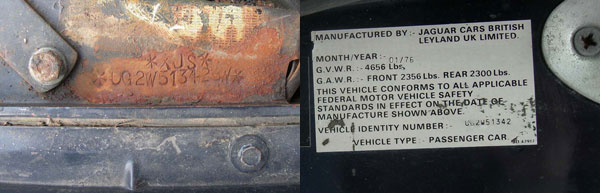 Left: VIN stamped into mount; Right: Door sticker
The VIN number can be found on the builders plate mounted on the inner fender under the bonnet (hood) until 1978 when the info was moved to the windshield tag and door sticker for North America. Many parts of the world have a VIN tag behind the windshield at the "A" post. Also, in many parts of the world the info sticker on the drivers "B" post has the VIN. After 1978 UK/EURO cars retained a builders plate under the bonnet.
 Windshield tags
And the VIN stamping was moved to the flat top center of the firewall for all cars. The car number/VIN is always found on the first cars stamped into the metal at the fender cross brace mount and later moved to the top center of the firewall. These stamped numbers may vary with a slight change in the coding as this is the factory ID number and it's used as the UK, and other locations, VIN. Other countries may use a slightly different alpha code on tags and stickers from the stamped one on the firewall.
There were also prefixes assigned to the 1975, 1976, 1977 and the first half of 1978 model years of 2W and in the United States (at least) of "UF", "UG", "UH" or "UJ" respectively. Some locals may add additional numbers and/or letters.
A suffix for the automatic cars was used with "BW" designating Borg Warner auto gearbox and in true Jaguar fashion this suffix was continued on after the change to Turbo Hydramatic transmissions and eventually dropped some months later.
In 1981 all prefix code related to various model identifiers, i.e. transmission type, RHD vs LHD, engine size, etc. The suffix has never returned.
Hi beautiful! Want to see my V12� Ouch that hurt!
The engine number for the V12 is at the rear top center by the joint with the transmission and the inline six cylinder is by the distributor.
 Inline 6 engine number
Gearbox Numbers
The gearbox number is located for Borg Warner and Turbo Hydramatics on a plate mounted to the side of the transmission and for the six cylinder auto ZF stamped on a plate behind the shift cable mount. The early V12 manuals used the Jaguar XKE box which has the number stamped on the cover plate.
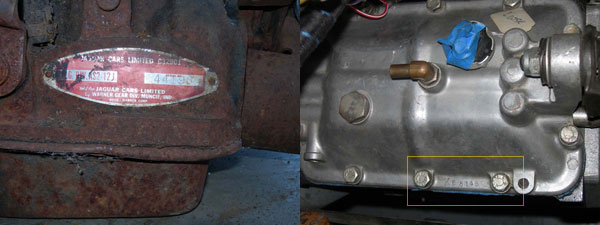 Left: 3 speed Borg Warner; Right: 4 speed Jaguar manual
 Left: 3 speed Turbo 400; Right: 4 speed Turbo
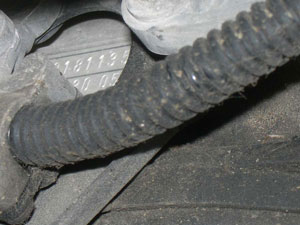 4 speed ZF auto
Body Numbers
The body number is behind the rear bumper inboard of the mounting strut on a small metal tag riveted to the car. It's easy to make a paper rubbing of the raised alpha-numeric characters rather than take a photo. New '95 and '96 cars require loosening of the lower portion of the bumper cover to access the tag, which really means removal of the bumper cover.
 Left: body tag as seen from under car; Right: body tag with chrome bumper removed
 Body tag exposed with complete bumper removal
So Why do I Get an Error?
Most entry errors on XJS cars in this database are because of too many or too few digits in the VIN number. In addition, there may be legitimate letter codes for certain positions that we don't have in our decoder. If you encounter this, please drop us a line and we'll change the decoder to accomodate for them.
You may leave a comment or question about this article:
2007-07-21 10:13:03 | Geoffrey Green writes:
Wonderful site Roger! This should make it easier for the owner to add those hard to find numbers. And clear up the different types of VINs. Thanks for your hard work!
2008-01-21 15:17:59 | Rodney J Butterfield writes:
You may be interested to record my ownership of a very early XJS prototype ( pre-production chassis) which has the VIN # 2W 50006 BW. I believe it will be the oldest surviving XJS as many of it's peers were destruction tested, or otherwise never escaped from the factory. I look forward to learning more about the history of my car if you have any information. Great to see a competent effort at registering all the XJs's. Thanks for your hard work.
Regards, Rodney
2008-03-13 02:47:22 | Edward Bowe writes:
A US enthusiast shared this site with me this month at the Wheels of Britian-2008 show organized by British Auto Enthusiats, a compendium of different British makes in a great presentation at Heritage Square in Phoenix, AZ. I had four cars, and parted one, so I will make every effort to revisit the site and add the other three, including the parted car which was badly rusted under a very presentable exterior.
2009-06-10 06:46:23 | Brett writes:
I'm very intrigued in the protoype XJS that Rodney has. With that VIN it is indeed very early in the production run. Have you researched its production date and its use? It's likely that it was a test or press vehicle. Let me know if you can please.
2010-08-22 04:45:44 | Roger writes:
I received this via email:
Thanks for the very useful site.
I would like to add a few details regarding the body nos. for XJ-S during my visit to Castle Bromwich, in March 1995.
At the time, each XJ-S had TWO body numbers, fixed to the under-rear-bumper area on two separate metal tags.
A. Jaguar "traditional" body number. This was the in-factory production sequence number, that was attached to every part produced for a particular car during final assembly.
Prefixes for the S were as follows:
7X: Coupe, 4.0L
7K: Conv 2 2, 4.0L
9W: Coupe, 6.0L
B. This may be referred to as "BMC" body number, as it is completely in line with Austin-Morris body numbering system that dates back to the early seventies. Those numbers consist of many details of importance to the body plant, that were meant to differ them from "other" BL products (and - yes, Jaguar was actually still using these numbers in 1995!).
The number was probably the sequential body number. I could not see it being mentioned during the final assembly phase.
XJ-S prefix is 2JB27D, followed by LF (2 2) or LX (Coupe), then a six-digit sequential number, then an L.
Also on this separate
Note that at the end of production for the XJ-S ,the production seq nos ("A") serve as a better tool in estimating production per version.
2011-03-17 11:53:01 | Hugh writes:
I have a 1989 XJS V12 Convertible. She is a left hand drive model built for the USA market and re-imported to the UK. I bought her in 1997 and now keep her in France and I am going through the process of re-registering her in France. The chassis numbers on the plate on the left hand side of the windscreen and the one on the V5 match. However, the number stamped into the metal at the rear of the engine compartment is slightly different. SAJNW484XLC168123 on the screen and V5 and SAJJNW4LP168123 stamped on the body in the engine compartment. This is causing grief with the authorities here in France and I hope you can shed some light on the difference. I would also appreciate it if you could tell me where to find the engine number.
Many thanks,
Hugh
2011-10-06 19:35:10 | Rod writes:
Hi. I just purchased a 1986 XJ-SC Cabriolet. The engine number on the engine is 8S476xxxx, but all documents show one digit different 8S473xxxx. Any reason for this? Thanks. Rod.
2011-12-27 18:30:53 | keri writes:
i have an early xjs car here in uk chassis number 2w1019bw making it the 19th right hand drive car and also the car used in the uk launch brochure does anyone have any information or know of any information about my car
thanks
keri jones
2012-06-02 00:35:30 | Randal writes:
I have an engine number of 8S805845G for an HE V12 Jag engine, how can I tell what year it was manufactured? Thanks.
2012-07-19 10:48:49 | UKAuto writes:
I had UG2W50448BW in Toronto, Canada. It was a left hand drive.
How early a car was that? Would this be the 448th made?, I have had various opinions in the past.
2012-08-12 07:53:40 | dean how writes:
hi all, my dad (Bob How) left me his XJS in his estate whe he died a few years ago, i believe its a prototype car and chassis number 1 or 2, which he bought out of the UK in 1975ish??? and returned it back to Australia. i have very early photos of the car and remember him telling me he took it out the bin behind the Jaguar factory somehow? I would love to confirm this, so is there anyone that could help with history or how to confirm this car???
2013-06-12 14:16:34 | keri writes:
i would love to see some pictures of deans prototype xjs, is it jvc481n
i own jvc810n and jvc480n is also here in uk please get in touch
2013-11-24 18:59:24 | Anonymous writes:
I have a very early 1989 XJS convertible. Build date June 1988. VIN 152267. Anyone have an earlier one?
2014-02-05 04:06:50 | Steve Wright writes:
Yes, mine is 150163 build date March 88, sold May 88
2014-11-29 21:56:53 | Gynther writes:
Hi, I am interested in importing a 1989 XJS convertible from the UK but to import into Australia, it must be built prior to 01/01/1989. The vendor cant find the build date but the Vin or chassis number is
SAJJNADW3DB167404. Any ideas on build date any body.
Thanks for any input
Desperate,,
2015-03-07 15:09:51 | Ryan writes:
Hi I am having problems finding out the year of my xjs as the log book has been lost the VIn on firewall isJNAEW3AC100680 Any help would be grate thank you.
2015-03-10 15:20:15 | John Lowney writes:
I just bought a 1994 XJS the vin is SAJNX278XRC193893 I think this particular model is rare in the USA. Are there any production figures for this transmission engine combination?
Thank you, John
2015-04-13 22:48:24 | Eric writes:
Hello
I was looking at a 1986 jaguar xj-sc cabriolet. SAJNV3846GC132402. This particular is in need of really serious restoration. I am wondering how rare this type of model is. Considering this model of xj-sc cabriolets were made from 1985 to 1988. I am also curious what were the production numbers of this particular model during 1986. I know some of them were sent to the US and Canada. Any information would be greatly appreciated. Thank you. Eric
2015-07-02 17:32:22 | barb writes:
I have an engine number 7P7204LA for a V12 Jaguar - Can anyone tell me which model and year this engine came out of - Thanks
2015-07-08 22:16:44 | Major Ian D. Newby writes:
My factory built convertible (NOT Hess and Eisenhardt) is 145606 built in October 1987. Westminster Blue with Magnolia interior; Jaguar factory licence plate E477MDU
I just acquired a 1976 black/tan coupe formerly in the USA; UG2W51482
I have some other XJS of various years; should I be posting their VINs somewhere?
Cheers!
Ian
2015-11-02 14:49:16 | Shawn writes:
Hello, I am a jag tech and have stumbled upon a 1989 xjs v12. judging from what your forum says the engine number is 9s66829sa, does that sound correct or has this engine been replaced?
2016-01-16 00:41:42 | yvon writes:
Hello i an trying to get the right engine numbers for a 1989 XJS built 11-88 SAJNL4845KC155996 CAN YOU HELP?? THANKS yVON
2016-08-22 20:22:57 | ALI writes:
Hi
I bought Jaguar XJS 1989, but I could not register it because the Vin # in the hod was different than the one on the doors and front screen left side!!!!
any body know what is going on please?
Thanks
Ali
2016-12-25 02:08:48 | oliver writes:
My VIN number stamped on the top of the firewall i clearly
SAJJNADW3DB162474 ( checked and rechecked)
When put it into the VIN identifier it comes up as an F type when it actually is a 1990 XJS V!2 convertible.
Anyone know why?
2017-01-07 20:02:45 | Denton Ford writes:
I have 1978 xj6l vin UJ2T69793BW tag under hood left fender is as you show , there is also
tag in door jam as you show , I cannot find a paint code anywhere , and paint I think on car is
original but I cannot seem to match . I am at a loss as to what paint code was and/or where to
find it ... it is green but I have had 3 British Racing greens mixed and none match ...any help
appreciated , thks
2017-01-16 08:11:27 | W. van Wanrooy writes:
Hi fooks,
I have a question. I own a xjs convertible RHD USA market vin: 152156 from production date 23 may 1988
das have some one have the production numbers from that year or has some one a earleyer vin number or production month
2017-04-08 02:21:17 | Bruce writes:
I have an 89 XJS Convertible VIN SAJNV4848KC160166 and I'm trying to find the engine # for it so I can tell if it has the old rope rear main oil seal or the proper, 1 piece neoprene seal. I know where the engine # is located, but I can't see the bloody thing through all the pipes, lines and grease.
Please help1
Thanks.
2017-04-19 19:05:32 | Claudio writes:
Hi. I am searching for a pre face lift XJS with an inline 6 engine and manual Getrag 5 speed transmission COUPE. I know they are very rare and would like to know how many were produced RHD and LHD? is anyone out there able to provide this info? please remember. COUPES only, not convertibles and not Targas (SC)Thanks.
2017-08-23 20:46:17 | Werdy writes:
I have a earley XJS Convertible 5.3 V12 USA vin 152157 may 1988 racing green deliverd to NY
Das some one have a earler vin or info about this car please send inform me
2017-11-25 01:25:33 | tim writes:
I need to identify a jag xj sport lying behind my house without plates. How do i send photos ?
tks
Tim
2017-11-25 01:34:05 | tim writes:
.....yes, i need to know the year judging by the photos.
2017-11-29 22:06:18 | Scott Strauss writes:
Hello, awesome information on what the numbers mean on early model Jaguars!
I have two different Jaguars I'm trying to find out about. I can not find a decoder that will take my car/chassis numbers, if you could help me out that would be amazing.
The first is a 1975 XJ12C Series II, chassis number UF2G50337BW
The second is a 1976 XJS, chassis number UG2W50351BW
I'm trying to find out information such as the original options that the car came with etc.
Thank you for you time.
Scott
2018-01-17 20:11:46 | Jan M. writes:
Hello, my 1982 XJS HE has VIN 105044. Is there any older one known of?
Thank you all,
Jan
2018-02-14 22:15:20 | Leigh Ewart writes:
Can anyone point me in the right direction to establish actual build dates or compliance dates from the Vin Number?
Please email me at Leigh.ewart@gmail.com
2018-02-15 22:01:19 | Niels writes:
Hi
I need help decoding this vin plat on a xj-s is there som one that can help?
2w54014
8s7911sb
gearbox KM1242
Best regards
Niels
2018-05-21 18:16:36 | Kevin McCabe writes:
Looking for help to determine what "L" is as the 5th digit in the vin of a 1988 XJS coupe. Pertains to the occupant safety system, but I am unable to identify what "L" indicates.
2018-07-13 15:16:07 | Tito writes:
I requested and received Jaguar Heritage Certificate for my 1988 XJ-S coupé.
I am surprised by the fact that VIN is the original one reported on the car while Body number is not the same.
What is the meaning of the two (VIN and Body) numbers? How is possibile to have punched the original VIN and a different Body number in a single-body car?
Thanks
2019-01-21 05:36:47 | danny writes:
dear, could you explain to me following VIN
SAJJNACY4CC125614
colours ( interior, exterio ) , options, build date, delivery date, ....
thx
2019-02-08 12:53:23 | Michael Ashline writes:
Hi,
from what I've read I have one of less than 10 1995 V12 XJS 2+2 convertibles imported to the US new. It has the painted side mirrors with brake light in the spoiler. I can't find much more information about it here in the US. Everything works fine. I drive it about once a week. Its up to 68k miles now. I've owned it a couple years and may want to sell once I finish another project for the garage space. VIN=SAJNX2349SC199998. Do you know where I can find out more on this?
Regards,
Mike
2019-10-31 09:41:33 | Lawrence Watkins writes:
I am puzzled by my "VIN" number: UH2J53527. My info on my car, as sold to me, 1977 XJ6C, squadron blue. One expert says it must be a 1974 based on the curved front signal lights mounted on the lower fender (not the bumper).
2021-01-09 17:17:15 | Paul writes:
In which MY did the 4.0s tick over on this engine # - 163523. ? Reason I ask is that is the beginning engine # that Jaguar decided to start including exhaust valve stem seals on.
2021-01-09 17:51:02 | Paul writes:
oops - noticed now that very helpful photo above for 4.0s (thanks, btw!) .. It appears that my engine # is a 195xxx on my '94 4.0. Does that sound about right (based on that of other '94s, owners)?
2021-10-13 14:57:45 | pauls writes:
Late to the party but this answer is for all and a reply to Ali above, he wrote:
I bought Jaguar XJS 1989, but I could not register it because the Vin # in the hod was different than the one on the doors and front screen left side!!!!
any body know what is going on please?
Yes. In the mid 80s car mfgs world wide adopted a new ISO standard for VINs.
en.wikipedia.org/wiki/Vehicle_identification_number
Jaguar continued to stamp their factory VIN into the metal in the engine compartment but placed stickers all over the car with the ISO standard VIN, note that the last 6 digits will always match as that is the car's serial number. The best advice I could give if your DMV or registration authority can't grasp this is to get a Heritage Certificate from Jaguar, it will state that (in the case of the USA) "USA VIN SAJxxxxxxxxxxxx". Whereas the factory VINS always begin with SAJJ. I believe Jaguar continued this practice until the end of its run. Note that not all countries adopted the ISO standard so quickly but North America delivered cars have the stickers with the ISO VIN.